
EDITORS’ SUGGESTION
Physical Review Applied
Toward a temperature-insensitive composite diamond clock
Sean Lourette, Andrey Jarmola, Jabir Chathanathil, Victor M. Acosta, A. Glen Birdwell, Peter Blümler, Dmitry Budker, Sebastián C. Carrasco, Tony G. Ivanov, Shimon Kolkowitz, and Vladimir S. Malinovsky
Phys. Rev. Applied 25, 064046 (2026) – Published 11 June, 2026
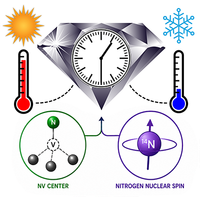
Although a solid-state frequency reference based on nitrogen-vacancy (N-𝑉) centers in diamond is attractive for compact, multifunctional timekeeping and sensing, their strong lattice coupling produces temperature sensitivity that has precluded a stable clock. This study uses the electron’s zero-field splitting and the nitrogen’s nuclear quadrupole splitting in a composite frequency reference that cancels first-order temperature dependence, reducing thermal drift by more than an order of magnitude. The results establish a practical route toward robust, chip-scale diamond clocks that simultaneously support magnetic, electric, thermal, and inertial sensing in a single integrated platform.Show AbstractPDF